DAR 18 v2 – Digital Audio Receiver With Extensive Input Options
- Excellent S/PDIF performance:
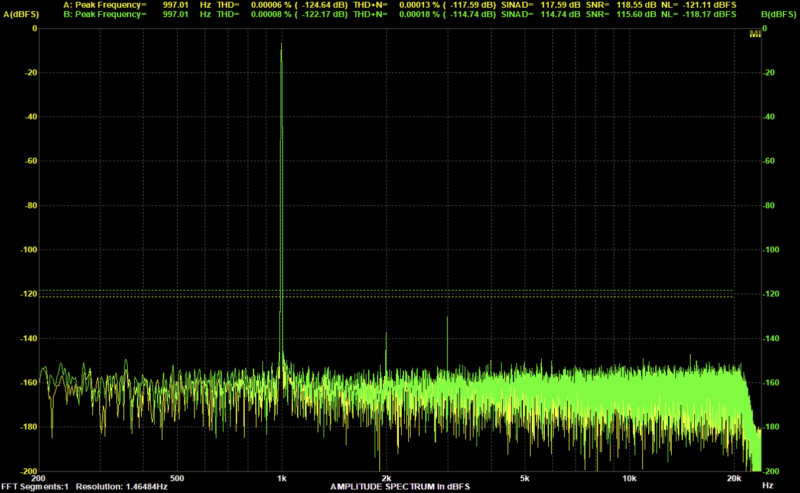
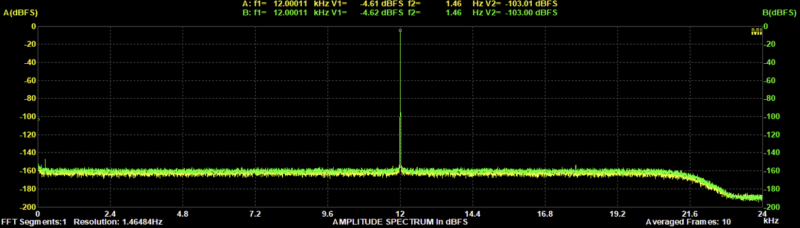
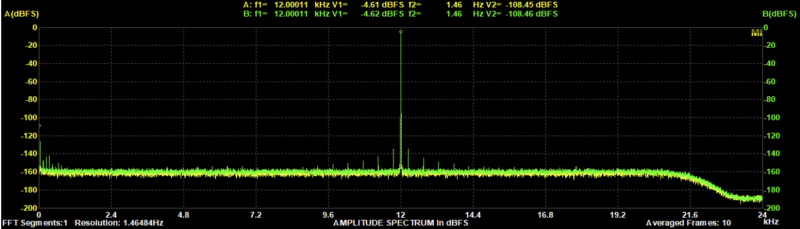
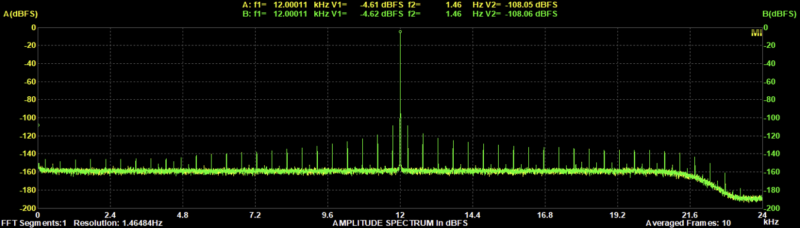
- Our reference DAC shows no measurable degradation in THD compared to direct I2S input.
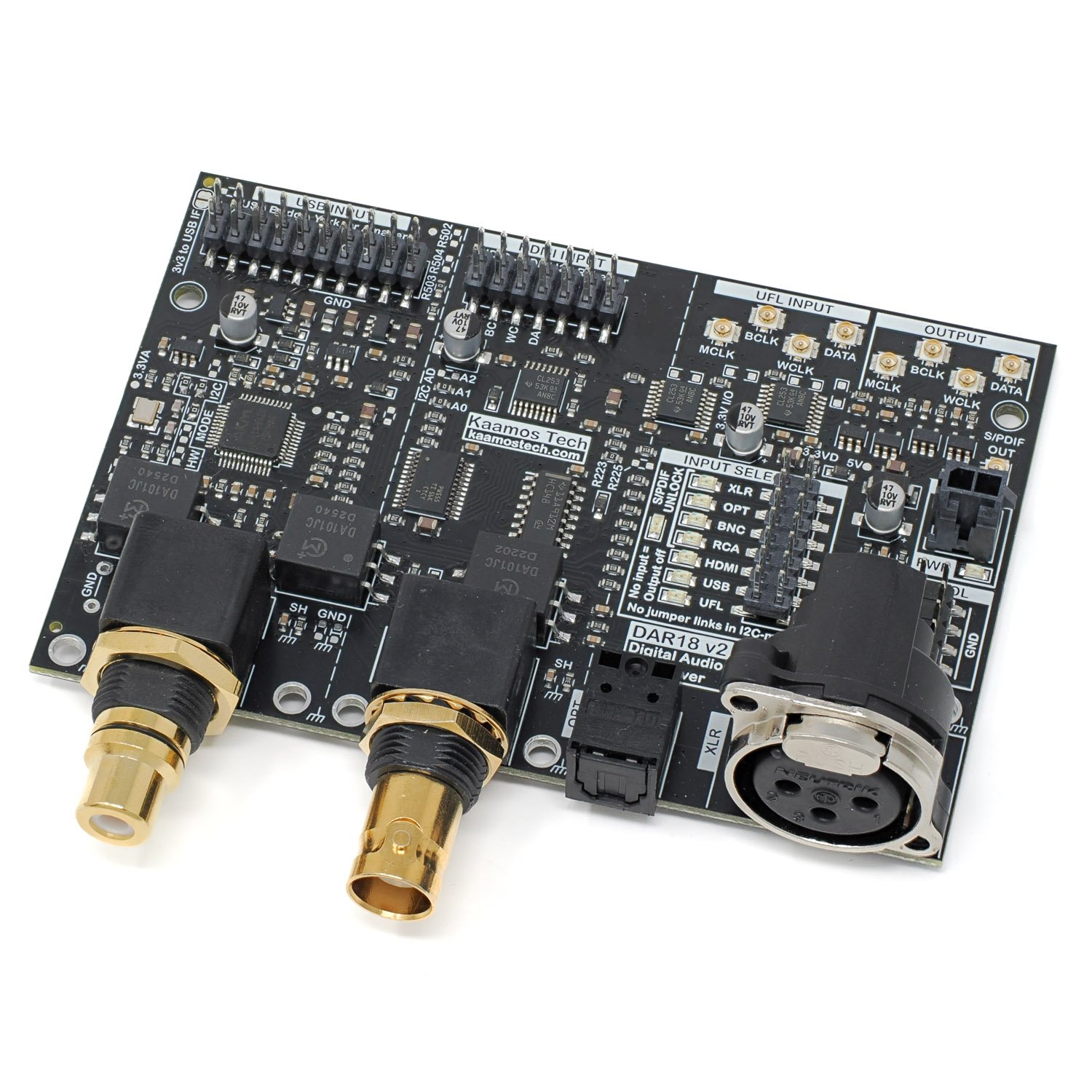
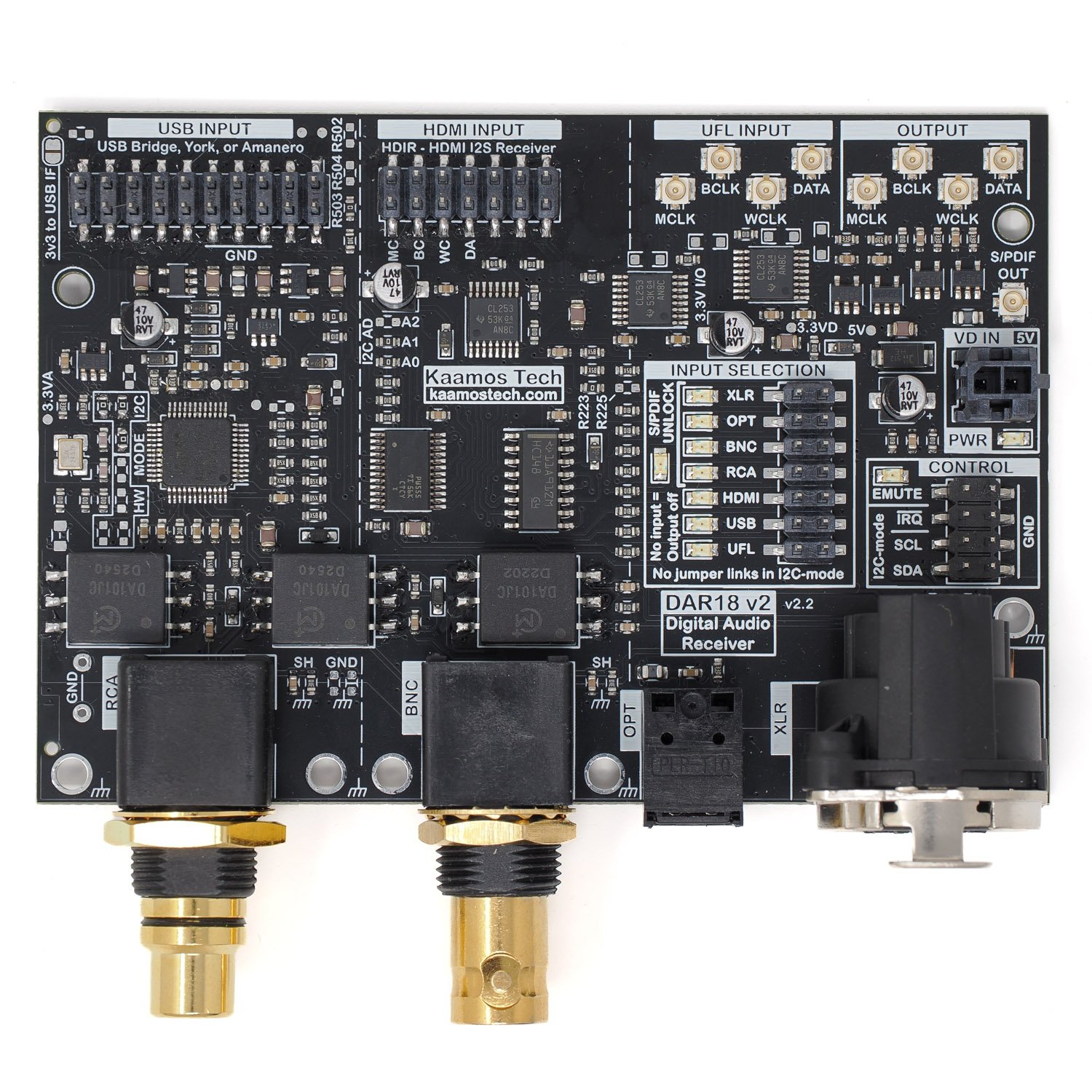
- Four galvanically isolated S/PDIF inputs: RCA, BNC, Optical Toslink, and XLR (AES3).
- Three digital serial inputs for external modules:
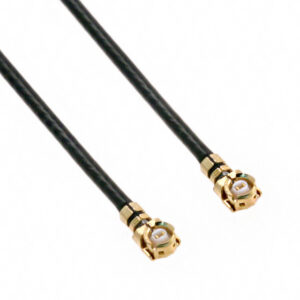
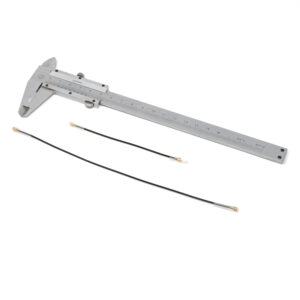
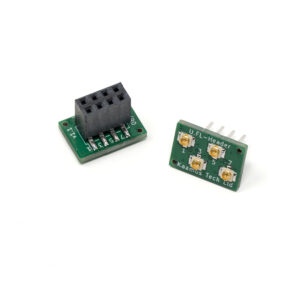
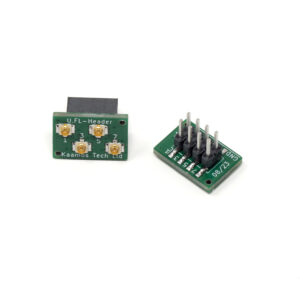
- UFL input.
- USB module placeholder supporting York Pico, Amanero, and upcoming Kaamos USB Bridge.
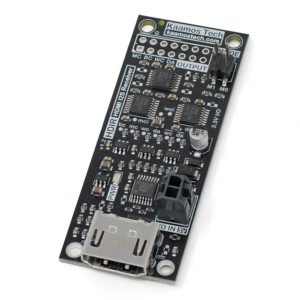
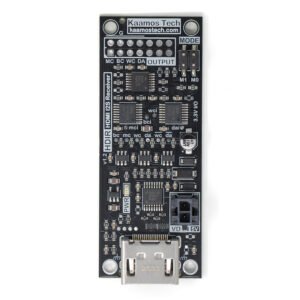
- HDMI input module placeholder for Kaamos HDIR.
- All serial inputs can serve PCM/I2S or DSD if the signals and pinouts align with connected devices.
- Up to 192 kHz / 24-bit S/PDIF input.
- It is not recommended to use Toslink over 96 kHz (its official specification) due to performance degradation and potential unreliability.
- Serial inputs do not have a sample rate limitation as they bypass S/PDIF circuitry.
- Digital output via U.FL connectors.
- Mute output to hard-mute the DAC or amplifiers when S/PDIF input is unlocked or not PCM audio.
- No I/O back-powering via S/PDIF or serial inputs.
- AK4118A S/PDIF receiver.
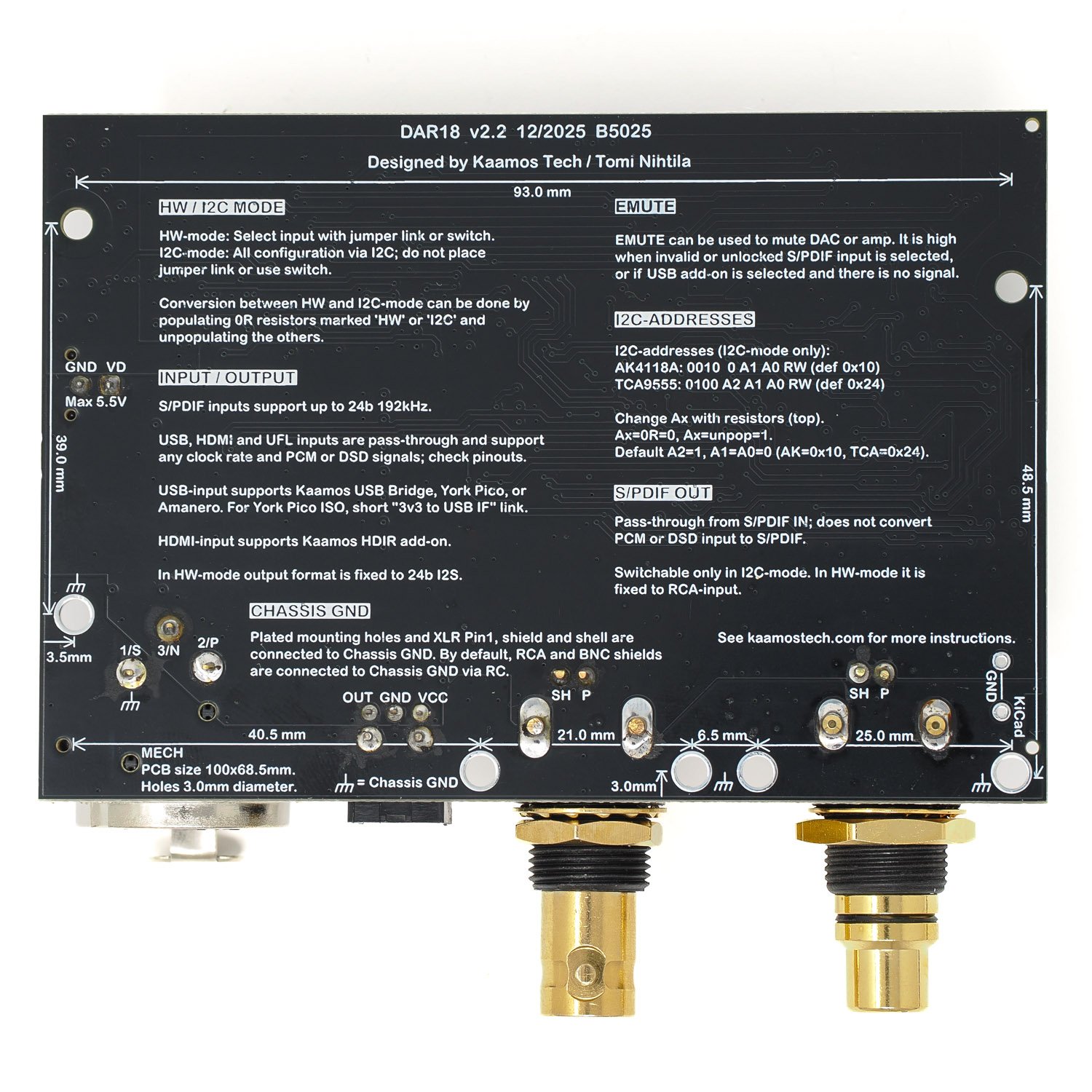
- 4-layer 100mm x 68.5mm PCB.
Requires the following supplies:
- 5V, max 50 mA.
- HDIR add-on powered from DAR 18 adds up to 30mA.
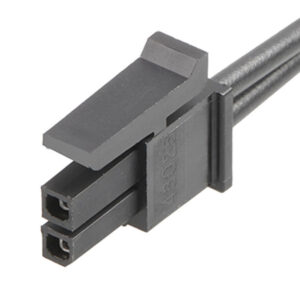
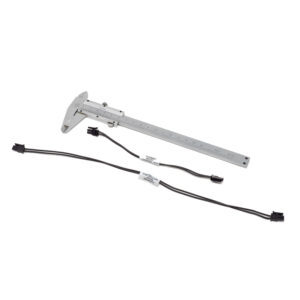
- Supply via 2-pin Molex Micro-Fit.
- If you use a non-Kaamos power supply, we suggest buying a 2-pin Molex power cable, cutting one connector off, and soldering the wires to your own power supply.
Features
HW-variant features
- Easy to use, no microcontroller needed.
- Input selection with jumper link, or use your own input switch/logic.
- If you use a rotary switch, we recommend a make-before-break type.
I2C-variant features
- Needs an I2C host, for example a microcontroller.
- Input selection and all other settings done via register writes.
- Needs configuration tweaks for the best performance, see DAR 18 v2 guide.
- Optional S/PDIF output via U.FL; routes S/PDIF input to S/PDIF output.
- The output is also functional in HW-variant but fixed to RCA input as it cannot be changed without register access.
- Explicit control of Mute output.
- We do not supply complete control firmware; however, code examples in the DAR 18 v2 guide assist with getting started.
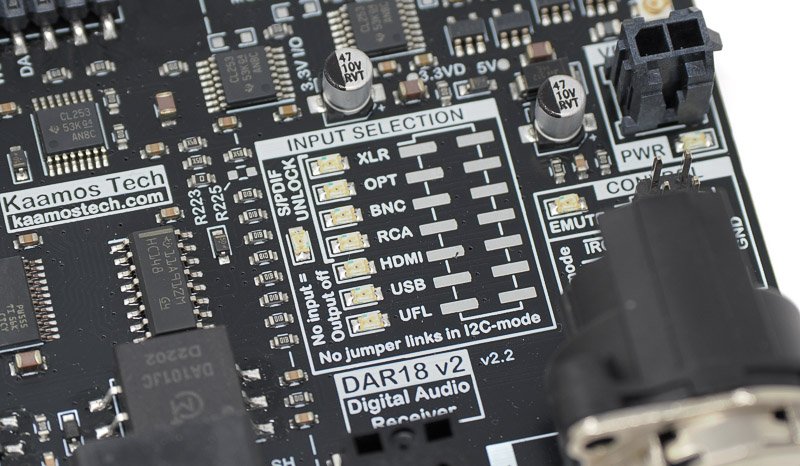
I2C variant does not have the header for input selection since it is done via I2C.
Signal formats
A few key points apply to the inputs, output, and signal formats:
- RCA and BNC are electrically equivalent, designed for standard single-ended S/PDIF via 75R coaxial cable at 0.5Vpp.
- XLR uses the same format on 110R balanced cable with a higher voltage up to 7Vpp.
- Toslink formally supports sample rates up to 96kHz; 192kHz is functional but with reduced performance. Overall, Toslink is the least reliable S/PDIF medium for jitter.
- While UFL, USB, and HDMI inputs ignore format details and therefore accept DSD or another digital signal, a few considerations remain:
- Serial inputs pass through basic logic switches, so the output mirrors the input; for instance, no conversion occurs between I2S and DSD.
- Output from S/PDIF inputs is always PCM (the HW variant is fixed to I2S, while the I2C variant also supports left and right justified formats).
- Verify that the pinout of the attached module (such as a DAC) aligns with PCM and DSD signals, particularly when combining both; AKM DACs operate well.
EMUTE output
Considerable work has gone into testing and reducing pops and clicks during input changes, sample rate shifts, S/PDIF or USB cable connections and power toggles during playback. Because how noticeable a glitch is depends on downstream devices like DACs, amplifiers, and speakers, we can offer only general guidance for system integration.
To manage possible pops, the EMUTE output (active high) may be connected to the DAC or power amplifier to mask them.
Please consider the following points regarding pop and click performance:
- The Kaamos W-DAC v3 avoids pops and clicks even without an EMUTE signal, owing to its own refined mute function.
- In a setup with an analogue volume control, pops and clicks tend to be negligible or inaudible because of the volume control attenuation.
- In a high-gain setup, such as a DAR 18 linked to a DAC that feeds directly into high-gain power amplifiers or active speakers lacking analog gain control, glitches may be heard.
- Please find more detailed information in the DAR 18 v2 guide.
Important information on order
- Boards are provided fully assembled and tested.
- Make sure you have the necessary skills to connect the board to your system and most importantly understand what you’re doing. Pay particular attention to ensuring you have the correct power supplies and signal levels.
- Be cautious with supply polarity and level. Incorrect connections can damage the board or your power supply.
- If you need help prior to purchase, please contact us.
More information
For more information on using the board, see extensive DAR 18 v2 guide. There is also a post on how to connect the older DAR 18 and W-DAC.
For measurement results and version history, see the tab above.
Files
We don’t guarantee a perfect match between the files and the board, particularly for mechanical designs based on 3D-models we have not verified. Therefore, please verify any dimensions on the actual board.
- Schematics v2.2
- Schematics v2.3
- Placement and dimensions v2.2
- Placement and dimensions v2.3
- 3D-model (.step 97MB)
Early I2C variants use v2.2 PCB while the HW variants are v2.3. The sole distinction is a minor enhancement in EMUTE performance for pop and click, which is irrelevant in the I2C version because the user manages EMUTE directly.